You are not logged in. You can log in or create an account to save favorites and join collections. more info
Abhidharma Kosa

The talk explores the profound concepts outlined in "Abhidharma Kosa," focusing primarily on the intricate relationships and distinctions between various states of consciousness and mental faculties. The discussion delves into the nuanced doctrinal distinctions detailed in the text and ties these to the larger philosophical debates within the Mahayana tradition, particularly concerning the true nature of existence and the notion of self.
- "Abhidharma Kosa" by Vasubandhu: Central to the talk, this text offers a detailed exposition of Buddhist psychology and ontology, including the enumeration and analysis of dharmas, fundamental elements of existence.
- Datu Niyapapadista: Referenced in relation to the exploration of faculties of the mind and their causal relationships, as mentioned within the context of "Abhidharma Kosa."
- Four Foundations of Mindfulness (Satipatthana): These provide a meditative framework referenced as a way to integrate the study of mental phenomena through direct experience.
AI Suggested Title: Mapping Mind: Consciousness Through Abhidharma

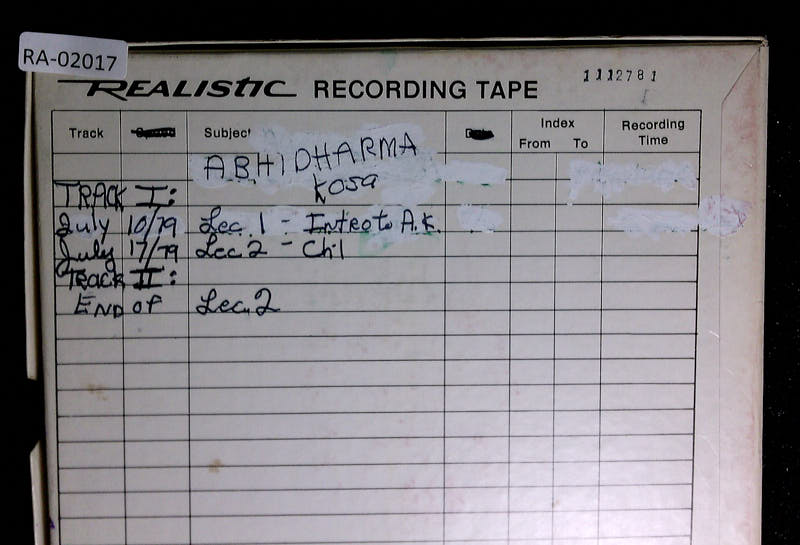
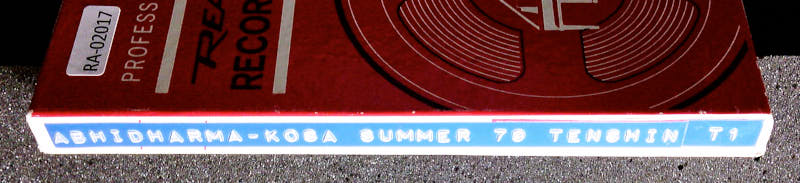

Side: A
Speaker: Tenshin Reb Anderson
Possible Title: Abhidharma-Kosa Summer 79
Additional text: Track I: Lec. 1 - Intro to A.K.
Side: B
Speaker: Tenshin Reb Anderson
Additional text: Track II: Lec. 2 - Ch1\nEnd of Lec. 2
@AI-Vision_v003
I'd like to pass out to you the mercy for chapter one. And then he finds these verses followed by commentary which explains something more about what's going on here. And last, I'd like to start out So I asked my cats to do it. They do it last week. First, we talked about where the outfit stands and the academic good.
[01:13]
There are actually two academic good, the point on the spot, the kind of position that may move later to . And the other one, . Well, I'm at February Tech. I'm here. Pastor Bander, the author of the Act of America, was a member of the By-Buster. Like the, by-Buster, that people who live this past me, didn't train this. We made, we made tech play at North Korea. But I'll be talking about it. which was the commentary itself on earlier. I guess on the earliest.
[02:18]
But the . Cool. It's out of commentary. And they were called the Abidama Koza Arika. And he was commentary on the birth called Abidama Koza Bashiw. And that was, that day was around 2015. And this text had some, had a political theory, The state issue was like a public inspector of the early tribulation. And so it has some of the Mahayana, maybe it's very close to Mahayana territory. And that protect, the government protect Mahayana, take more attention to the bedroom.
[03:22]
It's only to summarize the The main topic of birth to be attracted is going to be what we talk about in this book. The book to be attracted to the book. It's attracted to one of the books called the Dattu Neopadet. And it covers the Neodromand. And very, what she described by the Dattu Neopadet. And it covers the Neodromand. And very, what she described by the Dattu Neopadet. Chapter 2 is about the envy of 22 faculties of mind and associated violence, causation, certainly various kinds of causation, but various kinds of causes, results, and conditions, and various types of kinds that have been redacted.
[04:30]
was to deal with power of an unholtened state of my life. In the category, it would be, uh, located in the Delta. That's what the Buddha's heartmark takes for us, both over the place. And we got to tell us about that. Good topic for chapter one. We begin by the author, Payton Humbert, who has put the memorial on a doctor like a teacher. The word I had in honor of me. You're a part of it. I knew. I knew that I would not have to say that. It smells charlie. It's almost like a But it's not there, but it's a little bit.
[05:39]
So Abhijapa means . [...] It's based on the dominant image. It's a two, uh, five-travels element. Five-travels. [...] or created documents. When those documents are like, shh, shh, cooperate, or twerking together against it, to do, the people, cannot drop a document, but it has been created documents, or uncreated documents.
[06:57]
But the 72 completed documents again, when they're, when they're Then we talked a little bit about two kinds of departments. Cutting bonds.
[08:03]
This kind of reflection is possible through any connection. Through any connection. The bulk of entry into blood or oxygen. Although I couldn't use it. Did it call anything this? Because the sun yet doesn't actually make it happen. One depreciation of it is fine. And we just touched on the other guy. It's there. I'm from the town, I'm from the town of [...] the town
[09:33]
I guess when you're working to discern them, I'll see what they are. They live their ability to cooperate, speak. But then they start to leave it back. I wasn't going to say about the word cooperation. That might involve the pursuit of direction that the pursuit of depth is more of the use of that.
[10:45]
I guess from here, when you have nice collection, they just are uploaded, they all uploaded a view. This isn't a little clarification. I got it from . That's a very quick book for anyone. Before they say that the tower of the tower, they are perceived to be locked in certain relationships that go beyond their own being. The Arizona would find that having owned being only in the definition of the diamond, nothing but the only being diamond. And some of the definition will be relationships among diamonds, but then what they call other diamonds.
[11:46]
So some diamonds are just relationships among other diamonds. Functional possibility between diamonds, like a black diamond. Applicate, not the diamond. There's other relationship between diamonds which are not, for example, It would have a bond between unpleasant feelings and anger. It's not part of the definition of anger, nor is it part of the definition of negative thinking. Anger does not have to be associated with anything in particular. However, anger's definition is that it will try to get rid of something. But what it tries to get rid of, And so the fact that this potential activity in mind called voiding or destroying is associated with particular things and not others, that is what we call steam or kletia or bondage.
[12:50]
We do our fixed relationships in addition to own gain. They're not necessary, but we think they are. We perceive that they're dead. This association is called kletia. And at least I'm not going to look at the association. We'll be able to see if the government can arrive without that association. So call that cooperation . But this will begin . It's cooperation in addition to their basic definition, their basic comprehension. Well, I guess that I'd like to talk a little bit more about the posture of that, okay? When I talk about that, . Any other questions about that? Anybody talk about it?
[13:52]
Can you repeat? In addition to the question, I think there was a word that to find his imagination that the primary was not enough to know which is effective for their standards are also not. Is that true? Is that true? I was wondering with that about that. So in every moment, every moment of consciousness has a discriminatory function. When the mind comes up, it always has a pinch of the nation.
[14:53]
And the discernment of the situation, it's called , or it's also called . Right? But the Chinese character there is the Chinese character of the tulpa. But when the mind does not have fully developed the mind, then the discernment is not proper. It's called the tulpa. Difficult regarding the mind. Difficult regarding the tulpa. No. The difference is what the difference. In one case, you call it cronia.
[15:58]
Correct, but you know it just called cronia. Cronia. [...] It's called me false discrimination. What? False concept. Is policy very, uh, by definition, both of the same? No, not that means, it's just a word that means discern, in very state of consciousness, very vulnerable people have some level of offended. So people, but it's policy that's digital. Yes. It's not that. where I did not devote Samadhi. Without being able to stay on to the meditation object, you cannot discern properly. You'll get a fuzzy image. If you say this, and [...] this.
[17:01]
You have to be able to study something very thoroughly or to say the problem with what I did. and that requires some art. Now, in every moment, there's some art. So another moment, only one moment to read that term. However, we were searching in that very moment, in an area which you call past, in a conceptual area called the past, in a complete narration, which you call your permanent deterrence. You have, in that complete narration, your implication that you have not been concentrated for some time. Then you pull your Samayi's weak. And because you feel your Samayi's weak, you don't dare see exactly what it did. Therefore, you feel that you have not been concentrated long. Therefore, you feel you cannot see straight. Therefore, you don't see straight. But actually, with no Samayi, you can break them into the door.
[18:04]
It's all a samadhi right now. It's always going bonga. So you say it's not an act that something wrong with the mind couldn't be, that you couldn't see it, that you'd get a bonga. Because you can't gather up some other samadhi other than yourself. So the thing that you, that you're ever doing, it's supposedly that you actually do have false conception. You actually don't. But Sure enough, if you think you do, if you think they're not concentrated, if you think you haven't been concentrated, if you think they won't be concentrated, then in fact, that's a definition of destruction. You think you believe in destruction. If you believe in destruction, then you think, you perceive, meaning, or there's no one. Therefore, as it's called, I'll be making it up. Without the thing that would be. It's just, it's not real fault. but you think so. You [...] think so. Exactly what you see. But you're not believing it's such a stone thought.
[19:06]
But do you understand what I'm telling you? Yeah. What you're saying, it seems like that would be an event is only to The special balance, especially if they are not sooner. There wouldn't be anything in the Houghton Douglas, you know, in the Houghton. And why is that? Well, two hundred percent, they don't. This church was just an idiot, that's a bully. Very easy pick up there. That's right. If you look at it more carefully, you won't see it. I looked at it myself. I had to, I still play you a little bit.
[20:17]
But, only time it doesn't do it, it's all right. But, I knew I kept you, put too far. But that's right. In fact, if they don't have a common thing, that their definition doesn't really make sense. But still, you have to understand that it is because of that definition that you have what you have to do. We have to be able to see that if you have that definition, this would be the source of all of us. If you thought that was possible, then you could do everything wrong. Without thinking that's possible, you can't get rid of it. So if you find it up in trouble, you must be able to find that you believe in such a thing. But in fact, if you look carefully at what you believe, and see what actually they are, and get you to see what they need to do. Just like on your day off, you wonder what should they do?
[21:22]
Like I said, well, I think I'll go back since you like this. But then on your day off, You wake up, it's a sunny day, and you decide that you're about to win it for a while. And you read a book, and you don't assume. You remember, oh, we used to be able to buy sugar. And you get very upset. Why? Because you didn't buy sugar since that was your project for your day off. You forgot that you're going to get sugar. But you see, you just made it up. We will get in the top. But you forget, and don't look at that fact. Alright, so if we look at two versions,
[22:27]
The family raised the... ...presentator looked. He had, in an absolute way, destroyed all darkness. He had pulled the world from the mire of transmigrate. I ran their homage to him, to this master of truth, before expanding the treaty called Adhidharma culture. The Adhidharma... is immaculate prajna, which follows. It is against all prajna and the treatise which makes for the attainment of immaculate prajna. Because the meaning of the avidharma is within it, or because the avidharma constitutes the foundation of itself, the present work is called avidharma worship. Other than by the discernment of dharma, there is no way of extinguishing the passion, friendship, And it is by reason of the passion that the world wanders in the notion of its victims.
[23:36]
In view of this discernment, the Abhidharma was pronounced, it is said, by the master. We didn't put the bad critic in your past. No. We shouldn't see any word of critics. . [...] Then the kosha, which means make it an S-H.
[24:46]
And you have, but there's something with the alternate text. The group, nga, nga. It means to know. So, prajnana, prajnati, prajnati. And close job. Close job. And number five is Akasha.
[25:51]
And number six, AB, the Pratisamachana Roda, there's a dot over the M, and it's a long mark over the A, before the Roda. The third A has a long mark over it. And then, uh, that's enough, that's enough. And Sanskrit has a dot over the end, and a dot under the car. Okay? The dot makes it like a man. Makes a man like a man. Okay. You need to turn more like a man. It makes it like . [...]
[26:51]
. [...] Only, only where to put. So that under the slash over, and that's the person sent, bring me to the mirror. So we want to get one more. So I could say it on the end of the day, but we're going to the field. And Jared? You know, I would just say, it's just, uh, yarn, okay, yarn, [...]
[28:15]
Okay. Okay. Number one, we've already done. Number two, we've already done. Number three, we've already done. Number four, we've already done. And number five, I want to point out that you said, there is no way of extinguishing the passion. According to this tradition, only by the same amount that they are that they actually can't live by any other way. But I think that they are the same. All right. So you can pull up on the first time to use first two. I'm sorry.
[29:47]
Okay, now please someone read four through six, four, eight is six, three, three. One few of the problems are those related to the bite, true of it, but those not related to the bite. Conditions of it are impure. with the affection of the path. They are impure because the confinement are attached to them. The truth of the path and the true uncondition are pure. Spirit, akasha, and the two of station, erosion. Spirit is that which does not render. This junction, each disjunction taken by itself, Now, I'd like to repeat
[31:18]
. [...] And in this text, when they say pure diamonds or pure path, whatever, the word that they're using is, oops, this is pure. So when they say it here,
[32:22]
So the key word here, can you see this? Can you see this? So the key word is S-A-S-R-A-S-R-A-S-R-A-S-R-A-S-R-A-S-R-A-S-R-A-S-R-A-S-R-A-S-R-A-S-R-A-S-R-A-S-R-A-S-R-A-S-R-A-S-R-A-S-R-A-S-R-A-S-R-A-S-R-A-S-R-A-S-R-A-S-R-A-S-R-A-S-R-A-S-R-A-S-R-A-S-R-A-S-R-A-S-R-A-S-R-A-S-R-A-S-R-A-S-R-A-S-R-A-S-R-A We talked a little bit about this last week.
[33:23]
So you have these, you have a field of events, all right? Which, by studying on the Dharma, you can . Proceed. No. Understand. You need to feel the Dharma. The usual way of meditating on these is, first, It's one of the main ways to call these four foundations of mindfulness. What you talked about last week, too. What are those four? Anybody? A body, which is called . M-R-T-I U-P-A-S-T-U-P-A-S-T-U-P-A-S-T-U-P-A-S-T-U-P-A-S-T-U-P-A-S-T-U-P-A-S-T-U-P-A-S-T-U-P-A-S-T-U-P-A-S-T-U-P-A-S-T-U-P-A-S-T-U-P-A-S-T-U-P-A-S-T-U-P-A-S-T-U-P-A-S-T-U-P-A-S-T-U-P-A-S-T-U-P-A-S-T-U-P-A-S-T-U-P-A-S-T-U-P-A-S
[34:50]
plus two. Four. Four. The four. Shemitah means mindfulness, and Uprastahna means foundation and base. So the four bases are four foundations of mindfulness. First one is called, hi. Second one is called, they are not. Third one is called, these are the honors. One called chitta. And importantly called dharma. This is the fourth time. Mindfulness of body. Hyrosmuthiopatona means that you're mindful of body postures. You know, if you're standing, sitting, and lying down, it's practice like this. I'm standing. My hand is on the chair.
[35:52]
I am walking down. This is Khyas Ritupastana. Khyas Ritupastana can also be practiced with the body. In some other form, for example, you can follow the breathing. Following the breathing is Khyas Ritupastana. Anapanas Ritupastana. Following the breathing. Anapanas Ritupastana. Khyas Ritupastana. Also, to meditate on the repulsiveness of a rotten corpse. To meditate on the body in the very stage of decomposition. Okay? And so on. Many of the various techniques. All you can do is look at the body. Next one is Vedana. And that's classification of the simplest of the mental phenomena to observe two ideas.
[37:01]
They only come in three varieties, with two subdivisions, basically, body and mind, positive, negative, natural. They sit in meditation and stand in meditation, walk in meditation, and observe feelings. I notice that there's no hindrance between High Serenity Pistana and Vayan Serenity Pistana. Because you can say, you can be aware of you standing and also meditate on your feelings. You can follow your breath and also meditate on your feelings. This will be true of all four. But you start at the base or the top and work down or work up. But they're all in a hurry. There's no healing between them. They're all leveled at once. But at first you can't believe that. And next will be chitta smithyuprstana. And chitta, in this case, means chitta in that aspect of consciousness which speaks as an all-embracing quality.
[38:04]
So now you'll speak of consciousness in terms of general quality of the total totality of your experience. So you'll now use terms which are not dominant terms, but will be general qualities of your mind. Like you would say, the mind is distracted. The mind is concentrated. the mind is lawful, the mind is energetic, depressed, and so on. They're not done in terms, but you're able to now meditate on body, feelings, and now, in addition to feelings, feelings that are available to you, now also being aware of more, a little bit more of dharmic events, but not quite dharmish yet. The next step... will require that you learn. You could just learn Pais Khanda. You could just learn the 12 Iopens. You could just learn the 18 doctor.
[39:06]
But in this system, the next step is to learn 75 Dharmas. And by memorizing 75 Dharmas, and understanding very well their definition and their relationships, then now you actually are seeing 75 Dharmas. This is Dharmas Siddhi was done. So you can be aware of the body. The feelings, of course, because feelings are one of the 75. The general quality of mind, of course, because it's composing the 75 and the 75 itself. It could be aware of all you that want to speak. And the fully developed mindfulness, you know, it's all four. And when you can do that, then you'll be able to start studying the real reality to these two cultures. to these ashramas, okay? The ashramas, which we could, could be called outflows, leaks, blood, and words that I, you don't usually care, which I think you could alter it with implications, dharmic implications, implications.
[40:21]
Come on. There's a thing called mind, okay, or consciousness, and it has three basic meanings. One one is Chitta. The other name is Jnana. And the other name is Amanas. Okay. Or it's also called Manayatan. It's also called Manal Jnana Doctor. Okay. That's what it means. Each of these men will refer to a slightly different aspect of one thing. When we speak of Chitta, we're speaking of nine as it were
[41:21]
as it was the one thing other than the impression of the totality of mental functions. Is that a false impression? Is it a false impression? What do you think? I think they're not a false impression. First of all, you better see that it is the impression. That given mind, this chip never comes up by itself. It always comes up with those items in section number 3. All right? It always comes up with some stuff set of those 15 left here. Of those 46. The type of diamonds. Okay? The tip set. Some probably need to be dissociated. With what? With chip. The number category section number 3 are those diamonds that are associated with category number 2, which is they all encompassing. impression of them. The consciousness is nothing other than the impression of whatever of those who do not die as a member of three are present.
[42:33]
It's still their shape, their total shape and impression that they make in what? In awareness. And what is awareness? Awareness is nothing other than their impression. I need to write them through imperfect It's the impression that arises due to the opposite of Afratisankar Naroda. Namely, the impression that arises about something arising. If diamonds arise, you have this. If there's Afratisankar Naroda, if diamonds aren't even arising, then you don't have kitta. You don't have anything. But if you don't have perfect nirvana, and you're not in one of these states, state number 63, or 64, or 62, and after all, we know that, then you have mind and mental state.
[43:35]
That means probably . So if you think things come up, then that means you have a mind. If you think that comes up, that means you have a consciousness. And this consciousness never comes up by itself, but it comes up with a complement of other mental functions. And the chip that you put down will be talking about what's come up, but at a less technical level, a less specific level than the darkness would be done. But a more sophisticated level than the data perspective is done. Because you're aware of this, what's some other thing? But you haven't quite tuned in quite as clearly as you were up the next day. So what happened to you?
[44:37]
This is called dust with chalk. When you use this chalk, there doesn't need to be any more dust. This is the field of experience. I just made it this way. You can make it any way you want. And this is . This is, let's say this is . Somnia is perception or notion or concept. And as I say, in this course, I don't feel hungry to talk a lot about what somnia is. I'll talk about it, but I'll expect it's the first time you've heard.
[45:45]
And then let's say you have data on the... And we have sparsha. And we have tip. Tip that, let's say, not very box. The whole thing. The whole picture. The whole picture. How do we do that? Are you all sure? Are you all sure? Are you all sure? Okay. Are you all sure? And we have shrug. Then we have Salman. Then we have Mati. And we have Chandra.
[46:47]
And some other ones too. Now, A link is, so each one needs to have a definition on it. The definition of this one is that we have an object to indicate, but then you have a rupa, a rupa ayatana, a color. And we put it inside of consciousness. We could also put it outside of consciousness, In a school? School we're studying, actually. They think it's outside of consciousness. This group has a mark, has a .
[47:49]
Each one of these has a . Do you know that word, . a little slash at the top. Now I have to get the darkness devout, the block shana, DNA. Every diamond has a mark, a unique mark. The mark of stantana, of perception or idea, is that it brings the mark, the object of consciousness, into contact with consciousness itself. It notes the mark, it says. There's the mark. Excuse me, what notes? And that is Sanya's mark, that it notes the mark.
[48:56]
The characteristic. Now, what we're looking at now is to say, in addition to the blueness of being available, We can have, in addition to that, we can say that this is outside of consciousness. Or we can say there's blue. We can even say blue is outside of me. Or we can say the whole thing is a me, self. We can even impute to this situation. In addition to this concept, we can create a concept called a self. a certain definition, which includes certain parts of this field of experience.
[50:00]
As soon as you make that definition of inside and outside, or self and other, at that point, the implication of that will be what? Asarabha. By imputing certain classifications in addition to these dharmas to the situation which we can do, We have the mental equipment to do that, this equipment to do it. By setting up certain kinds of partitions and relationships, in addition to this, with this equipment, you set up the possibility of circuitry, of bulk flow, of loss and gain. This is where the idea of elite arises. It actually is not real. because actually you have communication within one field. But because you divide the field up arbitrarily or for some reason, it basically makes it more interesting.
[51:06]
And you can use your metal equipment thing better. You have stuff to operate on. By setting this up, you could lose energy and gain energy. You could be attached and you could be attacked. You could gain and lose. and so on. You can be upset and you can be calm. So upset and calm, gain and loss, happiness and sadness, all this will be due to imputing organization out of this in addition to this picture here. It's when you start seeing that when you start seeing all that's happening is these dharmas, these 75 dharmas, then the more, the less sophisticated model of the book Chitta Smith-Yupastana, namely the mind is agitated, the mind will not be seen as agitated anymore. Because agitation will be seen as due to an imputation in addition to what's actually going on.
[52:12]
And even the imputation, which creates a partitioning in addition to this field, even that, He will not make it. He will not create it. It actually goes into this category. He can step back from this field and he can say that he is not eating. But this action, this partition, actually is an event that fits into this category here. Or some other dharma. So, there's other diamonds, like Anchor, what do you name it here? It's Akiva. Or, and this is the same line, but I'll put it in here anyway.
[53:16]
Or Mohawk. These diamonds, in the field. But their various function in the field is doing something. What's the field doing? Doing what they failed doing. The birds themselves are in the field. They're just part of the field. But their nature is that they create some idea about the field. So it's an idea about the field that really fits in. Because of the idea that they create, Because of their contribution to the notion of what's going on, that, you know, for example, partying means you can get rid of something, to push part of it away, or kill part of it. Global means you can hold on to something that you don't already have. Of course, you don't have to hold on to what you already have. You don't have to hold on to all the stuff that's already here. You must be able to create something that you don't have, or something that you couldn't lose, that's already here.
[54:19]
Otherwise, if it wasn't here, you wouldn't be able to hold on to it. or even think about it, or even imagine to hold on to it. But that impulse to hold on to it is already part of the field itself. So if part of the field talks about other parts of the field and so on, they go through various kinds of dynamics which actually don't happen. But the nature of that thing itself is to think that way, or just to imagine that way, or just to impulse that way, just to wish to organize things in that way. But that wish to organize is part of the organization. You can't get outside of it. You can't harm it. But if you believe in it, if it gets associated with the notion, and the notion then has an impression on consciousness, then sure enough, unless you see how it is, unless you think, hey, I did this little trick, sure enough, you feel, oh, I've been attacked. I have attacked. I did want something. I've just lost something.
[55:21]
Now I'm upset. No, I'm not upset. I'm going to change it. This is how you do it. And this is called waiting. This is how they occur. But actually, they don't. All you have to see is how it works. Once you see how it works, you see it really doesn't happen that way. It just looks like it happens that way. And when you see how it really happens, the leak stops. But you haven't changed one thing. Nothing has changed. Project does not touch what's going on. It doesn't touch it. It's just the way it is. It's not one iota. If you find something that can change, we've got your idea of Prognan a little bit off, and you can do exactly what I just said is going on. We're killing some of the situations without realizing that the education is actually included already. And if you just see that, then if you just see that your idea of Prognan does something, it's already included, then that will be part of you. And then there would be no leak.
[56:25]
Because there's no place to leak to. Because there's no inside and outside, that just stood out. There's a long time called the inside and outside of the schools. But the idea of inside and outside goes right in. Inside and outside is included in one category. So the path, the word of the path, you can see this. And dedicate yourself to the observation of what's going on. And even though you still see the possibility of leaks, you feel like leaks are happening. You're dedicated. You can see it differently. Not to say leaks don't happen, but we'll see where leaks come from. How does it happen? Not to try to get rid of them, because if you try to get rid of them, you're affirming something which is illiterate. So to dry up all leaks, you see what's It doesn't mean you don't see it anymore, but you see the nature of it, like I said, and you actually see it.
[57:33]
You actually feel it. And then you think, well, now you see the Abhidharma level. The next step is that you'll see which the Abhidharma allows, and you see more than this. Freedom and pleasure is nothing other than discerning the dharmas. That if you look at the dharmas, as you were saying, and as you said last week, if you look at the dharmas, I remember this is not talking dharmas. It's the next step. But you have to do the first one first. Otherwise, you can't do this one. You cannot do it. You see, what is data now? Data now is the mark of the object of consciousness in contact with consciousness. Here's the mark. Here's the object. Here's the consciousness, here's the object conscious. They relate to each other. Where is the sound other than the consciousness and the object? It's imputed.
[58:41]
Positive, negative, and neutral feelings. Where is it other than positive, negative qualities? Where is it? It's just positive, negative. It's a category for this variation. But read it, right? Chetanat. What's Chetanat? Chetanat is the overall dynamic or positive quality of the total state of consciousness. It's where it will lay the land. It's the total pattern of all these forces and dynamics. What is it other than the shape of the consciousness in its dynamic function? What is it that there's nothing other than that? So you don't need it. Every one of them you don't need it. Every one of them are extra. And everything collapses into more. Without saying they don't exist. Every one of these sponges exist, but you don't need any of them. They're all extra. When you come down to any one of them, you see there's nothing other than the relationship between a thing and a name.
[59:45]
It's just names of relationships. These relationships do occur. But the name of them is nothing in addition to them. Each one of these things is a relationship. So all, in a sense, goes into spirituality. And you do not say they do not exist. It's just if they're existing, you have nothing but living with relationships among them. And every one of them are subject to this activity, this relationship. This is called optimism. And this will make a lot of the time. So look at one. Now. Vasa Banda comes in halfway between these two. He isn't quite, he isn't quite a Mahayanaist yet. But what he's doing is that many dogs, they vary in their usefulness or their necessity. And some are, all of them, from the point of view of Mahayana, all of them are what we call
[60:46]
all of them are pregnant, P-R-A, with a pillow over it, A-Lon-Lon-A, P-P-A. It's the opposite of drug. Pregnopting means these things that are set up, they're just accommodations in the field of reality. Travis, but not D-R-A-B-Y-A, B-A-Y. No, not B, it's D-R-A-B-Y-A. They're just accommodations. They're just wrapped, you know. Temporary accommodation, overnight stay, overnight, overnight between a common boundary area of the landing B.
[62:01]
the first level of liberation and final liberation. The first level of liberation is called, is to sing, uh, hudgala nairatamyam. hudgala nairatamyam. hudgala nairatamyam You know what? Yeah. [...] In other words, you see a lack of a substance or a recourse self or a fairness to the idea of personality.
[63:21]
You're free from that level of imitation of a self when you see these diamonds and you stop seeing these flows between are these associations and relations between them. The next level is a level of the partner Paramita and Mahayana called Dharma Naira. You see in front of the dharmas. They also did not actually have a self. This is also called, they don't have an own being. They don't have an own nature. Because their own nature is just relationships between dharmas. Samadhi is the one-pointedness of the mind of the relationship to the object. What is it other than your mind being one-pointed? And so on. It's only nature of lack of friendship.
[64:28]
So, first level, by studying average dharmas, you master the first level. And then by setting up the Mahayana then looks a little bit, or I don't know, a little bit anyway, looks more deeply and sees it actually . It's just set up. It's a good first step. It's a big second step. Now this, I'm telling you something more about the question there, but . Because as you'll see, if you study the text, you'll find that it often challenges the variety of nature of these diamonds. The Dravya nature. Dravya means the substantial, substantial reality. So the Thakostabhar, if I could say that all these 35 diamonds are real, and they actually exist. They're Dravya. All of them. Vassipangu only allows part of the Dravya. A lot of other, what you'd say, these are just, but it doesn't do to the whole list.
[65:33]
He doesn't do it for everything on the list, just for some of them. And particularly, he does it for those which are not talked about in the citrus. OK? Because in that case, he takes this . He's one view of the citrus. He only didn't talk about these relationships. He said, where did you get it? You have it down, people think. What kind of thing you have it down? He's a relationship where they saw necessary in order to make the analysis work. And he said, boy, you need to make those. But some other ones he lets stand. Some others he lets stand. But he carves away a lot of these and says, hey, you need to make this stuff up. This isn't real. But he used part of the edifice standing before he goes off. That's the next word. but he mutilates it pretty badly in some way.
[66:37]
Yes? But not as badly as non-docrine as it did. Yes? Can any violence be used for that? No. But ultimately, no. But initially, yes. For example, even in healthy minds, somnambola will be operating. But you don't have to have an eater in a healthy mind. It's dispensable. But getting out from a louder-down point of view, what's English based on? The kind of level of misunderstanding that English is based on, is more gross than the level of misunderstanding that Somnia is operating on.
[67:44]
Only way you can have anger is to think that there's self and other. But you don't have to get into that to have your perception. Perception, all you've got to do is have something at risk. Which is nearly as gross a concept and nearly as troublesome as self and other. Why? Because you still think something came up. You still think something exists. And Buddhism does not say things don't exist. It doesn't say they don't exist. It just says they do not exist. It's not that they're not existing. It's that they aren't existing. They're not in a category called existence. does not mean they're often in the category of non-existence. So, prajnapti doesn't mean that they're, prajnapti is not the opposite of truth. Prajnapti means non-existence. Prajnapti means it's just illusion. We don't get into saying illusion doesn't exist.
[68:47]
We don't say that there are no temporary accommodations to human life exist. We say it just exists. It's just what it is. You don't have to say it exists. So you're operating at this level, and you're operating at this level of anger and confusion. It's much more gross kinds of emotions and gross kinds of implications. But when you get rid of those, you still think these are operating. That's much more subtle, but not good enough. unit, because you still think there's something there. So it's not . It's not the ultimate nature. Which Dharma is most likely to give you the . What? Which Dharma is most likely to give you the impression that there is the . The most valuable place in the creation of self are .
[69:56]
That's why, I mean, of course you said, that's why they get to be open, so it's going to be, get a whole scondent. So if you look at the data list, under the categories, category three, the first two data list, number 13, 14, they get a whole scondent. All the rest go on one stone. And that's because the scounder, the emphasis of the scounder system of classification of these diamonds. These 35 diamonds, 70, 70 proofs, these 35, 32 of these 75 diamonds. All the leaking diamonds. All the diamonds that you use to make leaks. Those all go in five scounders. And five scounder classification is certified. The only word of the teaching of the Fai Skanda is to show how the self was created.
[71:00]
If you understand the Fai Skanda, you mainly relate to the imputation of self on the mental and physical events. And to understand how you build an idea of personal self, of personality, feeling and perception is very important. So that's why they get their own Skanda. The other ones are important too, but just percentage-wise, they're not as significant. This is the very important point about religion. The difference between the path and the non-path. The very same dharma viewed by . In one case, it's Buddhist practice, where we developed with real Buddhist practice. In the other case, it's creating more trouble, continuing more trouble. It wouldn't be exactly the same time because it's certainly the case with Mohawk.
[72:08]
If you don't want to see Mohawk been there, like if you wouldn't go away, it wouldn't be. That's right. But Mohawk will not coexist with, right again. That's right. So, not exactly the same time as the case of the past. Well, you say in a moment of prajna, you say pure prajna and entourage, okay? Entourage, we don't find in its entourage moha, right? Because even moha there, you see moha for where it is, so moha doesn't have moha. So prajna has a certain entourage, in the entourage, you won't find too much junk.
[73:11]
However, this is an important point, that you could have those same diamonds and have a situation of a big cult. Exactly the same diamonds could be a situation of all the things. Can you stand there? When it comes to this question when I saw it, it says that the path, all the created dharams, can all be the path with correct discernment. But how can MOHA be the path because you discern it correctly, it's not MOHA? You can recognize what the nature of Moha is. You can see Moha operate. You can see how Moha operates. And Moha, when you see how Moha operates, there's no other kind of Moha but that.
[74:14]
And Moha is there. But Moha is now an algebraic of Chikra. So it looks like a different Moha. Moha doesn't seem to be able to attack But what is, if you probably saw Moha, you'd see. You'd see Moha. Exactly, Moha did. You'd see, could be, could you say, how can confusion cause this with discernment? It can't. That's true. But discernment knows what Moha is. And when discernment knows what Moha is, where's Moha? It's right there. You see, it's magic. But you see, we don't want to make a difference. We don't want to make a difference. There's a difference in the problem.
[75:14]
In one case, what's the nature of Mohawk? Is it any different from what the nature of Mohawk is? Is there any difference? If there's confusion, it's confusion. It has a certain nature. It doesn't know what's going on. It doesn't know if it's positive or negative. You don't know whether it's positive or negative. It's just one way to talk about confusion. So you've got Mohan. Now, if you can't see that, Then we would say there's still discernment. But we don't call it cognitive at that point. Because it's not a clear discernment. Because you don't feel... You say, I can't think clearly enough. I don't have a hard concentration. I don't know what's going on or not.
[76:16]
Just see the nature of this confusion. I feel a negative confusion. That confusion. They say, okay, now I can see that confusion. All right. But now if I see things exactly as they are, then how could there be moha there? Who knows about this moha? How could we talk about this moha unless somebody saw it as a boy and talked about it? Who would want to see this moha? Now what's he doing when he saw it? He saw it while he listened to it. So at the level that he's done and exists, he can also exist with . When, of course, they're probably still exactly as they were before. They lose their power. They lose their power. It's not. They say it not more highly. It's not more. Because it can't elude. It can't confuse. It can't play the situation. But what's its nature? It's nature exactly as it was before.
[77:17]
So they probably didn't do anything other than just view what is happening. They didn't stop adding anything to the situation. At the moment you stop adding in the situation, you're not with 12 partners. So what do you do?
[77:30]
@Transcribed_UNK
@Text_v005
@Score_49.69