You are currently logged-out. You can log-in or create an account to save favorites and more. more info
Perfection of Wisdom
AI Suggested Keywords:
The talk delves into the concept of "thought of enlightenment" within Mahayana Buddhism, emphasizing teachings in the "Abhisamayalankara." Specifically, the discussion focuses on the omniscience of the Buddha, detailing how the Buddha perceives all modes of knowledge simultaneously without grasping them as real entities, contrasting with the understanding of Arhats and Pratyekabuddhas. The bodhisattva's practice of non-grasping distinguishes them by accruing merit that is transcendental and esoteric, fostering a progressive understanding that aligns with the ultimate knowledge of all modes.
Referenced Works:
-
Abhisamayalankara: A critical Mahayana Buddhist text that outlines stages of understanding, categorizing types of knowledge such as omniscience and paths of different practitioners. It is central to this talk as it serves as the foundational text for discussing the various modes of enlightenment and the progression towards the ultimate wisdom of a Buddha.
-
Prajnaparamita Sutras: Although not explicitly named, these are alluded to through the concept of "perfection of wisdom" (prajnaparamita), which underlies the teachings of the non-duality and non-grasping wisdom of bodhisattvas and Buddhas.
The discussion is situated within the context of Mahayana thought and the process of enlightenment, shedding light on the transformative journey of practitioners towards Buddhahood by embodying wisdom beyond conventional merit and knowledge accumulation.
AI Suggested Title: Enlightenment Through Non-Grasping Wisdom

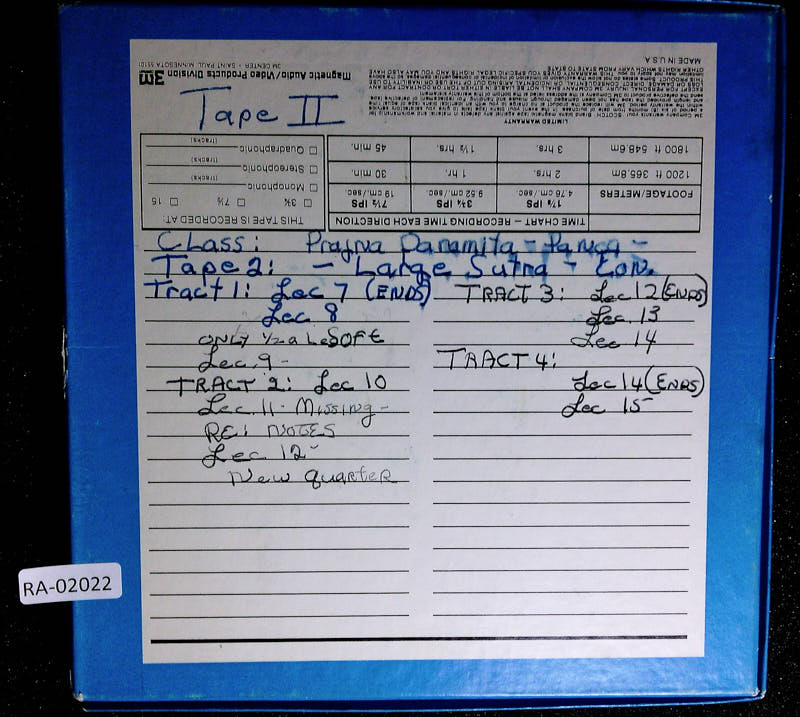


Class: Prajna Paramita - Tape 2 - Large Sutra
Tape II
Track 1: Lec 7 END Lec 8
only via Losore Lec 9
Track 2: Lec 10 Lec 11 - Missing Ref. Notes Lec 12 New quarter
Track 3: Lec 12 END Lec 13 Lec 14
Track 4: Lec 14 END Lec 15
@AI-Vision_v003
Last week we discussed a little bit this section on these various displays of the Buddha. And we could spend a long time on them, but if it's all right with everyone, perhaps we can go on to Chapter 2. Do you have Chapter 2? thought of enlightenment? Did you receive a reading assignment on the thought of enlightenment? Did you get one? Did you give him one? Anyway, the thought of enlightenment in Mahayana Buddhism is discussed all over the place.
[01:04]
And the teachings on the thought of enlightenment vary according to what phase of Mahayana you're talking about. And if you're interested, later perhaps we could discuss the development of the teaching of thought of enlightenment. But for now, perhaps we could confine ourselves to the teaching that directly comes up in this text, namely the teaching of the thought of enlightenment as given in the Abhisamayalankara, which is embedded in this text that you have. Let's read up to AA1B14, which is on page 49.
[02:44]
Let's read that together. When the Lord saw the whole universe, the world of God, the world of Mars, the world of Pratma, and also the Bodhisattva, when they reached the state of Buddha, he said to the bear, a Bodhisattva, a great tree who wants to follow. It should make the efforts of the profession of wisdom. It should make the efforts of the profession of wisdom. It is Shari Luther, a bodhisattva, a great being. It is a student of the profession of wisdom. I think I understand that it should protect the profession of dealing. I believe the student of the organization of the state relates.
[03:56]
. [...] He should protect the protection of wisdom, but I can't help today I have to get a break and see if it was with my stupidity. More of a little bit more excited about a great team to want us to get to the environment. It is just about the environment which means I'm thinking about it. . Likewise, . [...]
[04:59]
. And it was a big issue with the person. What are the words aside from the great people who want to sit up for the older artists, [...] It served a question of priority, a question of wisdom, a question of wisdom, and a question of wisdom, a question of wisdom, a question of wisdom, and a question of wisdom, and a question of wisdom.
[06:19]
and five documents and five powers, the seven names of the Black women, the eight of them. The teacher developed the MTS concentration, the Zionist concentration, and the bishop's concentration. The teacher developed the four choices, the four commitments, and the four qualities of statements, the eight of the differences, the dynamic statements of successful statements. to deny the end of the perceptions, with shining evidence that is like in the response of a corpse, a reading corpse, a pedestrian corpse, a blind corpse, a foolish corpse, a corpse to eat the leopard, a scared corpse, a dormant corpse, and a corpse of lonely gums. It is used to develop the perception of repulsion from a fool. . [...]
[07:44]
for everything in the world, the coalition of the . The coalition of [...] . . . . . . I've got to be found with me to say, with three languages, with four analytical languages, with four practices of countries, with five imperishable super languages, with secret actions, with state of crisis, with eight discursions of supermen, with eight power of superpowers, with eight different darkness, with great international, with great democratic joy,
[09:14]
the great name of my niece. I feel sorry, but the great name of my niece, [...] . . . . . It could obtain the sex supermanages to become aware of the rest of the un-symptomies or opinions.
[10:20]
It should advance the recognition of all the staples and projectile bullets. It could acquire the rolling doors and construction doors. It could establish the two meetings in hearing. The staples and sopads in redress to jump in and pay off the samples and projectile bullets. One of the funny things that one of the single production and the plot was associated with rejoicing. It was sad to stay warm up with morality. Although it was bad because of patience, it was a lot of volunteer. One of the little sort of conservative thoughts to chance, and it's been a little interesting. I'm not going to stop, but I can't really look towards the end of my simple conversion of the single production and thought during the technology of all problems. . [...]
[11:37]
There are all things that have the knowledge of our members take to an extra moment to track the perfect wisdom. We'll go over to the other side of it. [...] occasionally through the different sufferings of the house, and the births in the world, yeah? I let regard the beams to the elsewhere gained from morality, that would have been filed in the proceedings. It gave me the heart that we would have. It should be a minor characters to spend with the marks of summary. It would have shaped my body in the room. It decided on this debate about things. . .
[12:37]
. For example, a great piece of trade perfectly is that it was to fulfill the wishes of all people who gave a difference for kids to survive in this wild west in a sense, in its own wild west, [...] in its own wild west. A world of silver, a world of silver, a world of silver.
[13:38]
A world of silver, a world of silver. A [...] world of silver. Now we come to the part of the text where the commentary is embedded in the text.
[14:56]
We come to the beginning of the Abhisamayalankar as it applies to this text. The Abhisamayalankar, you have this sheet, right? Look at the sheet, you see that the Obviously my Lanka is broken up into eight main parts. eight main parts and 73 small parts.
[16:10]
The first three of these eight, as you can see, are about knowledges. So the first three describe different kinds of omniscience, different kinds of knowledge, of total knowledge. The next four describe methods to attain these. And the last one, discusses or shows the results of these practices. Any questions about this? What did you say, five to seven? Four through seven are methods or means practices by which you attain the first three.
[17:51]
And then the eighth is the result. The first category is called the Knowledge of All Modes. sarva, akara, jnana. S-A-R-V-A, sarva means all, akara means aspects or modes, and jnata, J-N with a tilde on it, A-T-A means knowledge. So knowledge of all modes or knowledge of all aspects. This is the knowledge of a Buddha.
[18:56]
The next category is the knowledge of all paths. Marga. M-A-R-G-A. Marga's path. Akara. also aspects or modes. And again, jñāta, knowledge of the various aspects of the different paths. And the next one, simply called all knowledge, sarva-jñāta, s-a-r-v-a-j-n-a-t-a. The second one, marga-akarajñata, is the knowledge of the bodhisattvas. The third one is the knowledge of the arhats and kratyata buddhas. And the next one, the full knowledge of all modes, is Sarva-Akhara Abhisambodha.
[20:34]
So Sarva-Akhara you already have, and then Abhi, A-B-H-I, and Sambodha, S-A-M-B-O-D-H-A. Abhisammaya can also be said Abhisambodha. full understanding, abhisambodha, full understanding or full awakening to all the different modes. And the next one is called full understanding and its limits, and that's murdha abhisamaya. Murdha means the limit, I mean the summit or the height. M-U-R-D-H-A. Murdha abhisamaya. And then the next one is gradual reunion. And that's anupurva avisa maya.
[21:38]
Purva means the following or subsequent. Anupura means to subsequently rejoin. To rejoin. sequentially rejoin. Anupurva. A-N-U-P-U-R-V-A. Abhisamaya. The gradual reunion. And the next one is the instantaneous reunion. And that's Eka Kshanna Abhisamaya. Eka means one E-K-A is single or one. And Ksana, K-S-A-N-A, means moment. And Abhisamaya. So in one moment.
[22:38]
To have understanding in one moment. And finally, is the reunion with the Dharma body. The result of Buddhist practice. And that's Dharmakaya Abhisamaya, Amhisambodha. Dharmakaya Abhisambodha. So these are the ten main categories by which the Abhisamaya Lankara teaches the esoteric meaning of this sutra. And now we're under the first subcategory of ten under the first of the eight main divisions which is called varieties of thought of enlightenment. So this category is under the omniscience of the Buddha.
[23:50]
So now we're studying, this part of the sutras is teaching about the omniscience of the Buddha, the knowledge of all modes. Any questions? The modes are the same as the paths.
[25:04]
In other words, modes are all not only all the facts you know, but all the facts from everyone else's point of view, too. So it means the Buddha knows things from all points of view simultaneously. The bodhisattva is studying or knows all the different paths. traversing and practicing all the different paths, but does not yet know all modes. And the Shravaka and Pradyega Buddha know one path, usually. This is the path of the Ahat. And this is also the path of perhaps a non-Buddhist sage, but one who knows by means of one particular root.
[26:09]
So I don't know who you want to pick, but I don't know who you want to promote to the level of Pratyeka Buddhahood. Perhaps you want to pick Albert Einstein. But maybe we shouldn't be too specific. Anyway, he may not have been able to practice and have this understanding from the point of view of various other professions besides being a physicist. For example, he may not be able to know what he knew from the point of view of being a truck driver or a car salesman or a midwife. Whereas a bodhisattva attains an understanding. I shouldn't say attains an understanding. Comes close to attaining an understanding along one of these modes which the arhat or the pratyekha Buddha know that doesn't grasp that understanding.
[27:16]
And then gives up that mode and goes on to another one. Pardon? What? But not just a thief, but a thief that understands. And it was understand by means of through a thief. Bodhisattva cannot have a dualistic conception of himself versus the thief. What do you think?
[28:28]
That's right. The Arhag and the Pratyaka Buddhas actually grasp the fruit. They actually grasp the fruit. of these knowledges. They become what we call fields of merit. So the Arhats, Arhats and Paginaga Buddhism are fields of merit in India. Bodhisattvas are not. Bodhisattvas do not become fields of merit, fields which accumulate or embody their effort.
[29:40]
That's because Bodhisattvas do not apprehend their own practice as real. Because Bodhisattvas practice these meditations signless to which there's an emptiness. So they will not grasp their own life. Now, since they don't grasp their own life, they will also not grasp other people's life. Since they do not grasp their own life, they will not be hindered. in joining or entering other people's practice or other people's life. Or since they don't grasp their own life, their own practice, they also do not grasp the discrimination between themselves and others.
[30:44]
It's not as though their mind can't discriminate between a Rocio and you. Rather, they don't grasp that discrimination as real. They don't deal with their own body and mind, their own experiences. They don't deal with other people. By virtue of that, they can enter into various beings' life and know various modes. So they must be able to know and enter into the life of the thief without grasping being a thief, because that wouldn't be right, that there is no thief. However, on the other side, to the extent that there is a thief, they know that, just short of grasping it as real. This practice, exoterically, means that the bodhisattva is not a field of merit, does not accumulate merit. But esoterically, this is the greatest merit.
[31:45]
The merit of this kind of practice is decalculably greater than the merit of driving things. The bodhisattva, as soon as there's an apparent, as soon as they feel some merit accruing to their body as soon as they feel some merit accruing to the body they they automatically give it away they dedicate it to others but this is very this is almost indistinguishable from the fact or from the feeling of not grasping the merit in the first place so whether you Don't grasp the merit or the activity in the first place. Don't grasp the activity and take it as real, which would give rise to merit in the first place, or whether after you get the merit, you give it away. It doesn't make much difference. So by this kind of practice, when it reaches its ultimate, this is the knowledge of all modes.
[32:49]
This is a Buddha. But then a Buddha is also So then the bodhisattva, after not being a punyakashatra, for limitless eons, after never grasping the merit, after never taking his practice or other people's practice as real, never grasping them, by that practice he becomes finally also a field of merit, a field of virtue. But this is the ultimate field of virtue. This is the Buddha's virtue, the Buddha's merit. And it no longer has to be given away because this is what real merit is. This is absolute merit. This is the knowledge of all modes.
[33:51]
So the knowledge of reality all points of view simultaneously in one moment. That's knowledge of all modes. It's not that Buddha knows all the modes like a great gem and scoots around the surface of the gem and gets all the different points of view. They're all true points of view. He doesn't even take them one at a time anymore. They're all simultaneous. In other words, never is one without the others. He no longer takes one and even says, I'm taking this one, and now this one, this one. But rather, this one always includes all the others. That's the only kind of knowledge they have. Always simultaneous totality. There's no point of view anymore. There's only all points of view. And now, we're under this section.
[34:59]
The siddha starts out, according to this teaching, starts out from this point of view, the knowledge of all modes. ... So you see, one point of view, ordinarily one point of view is grasping itself. But now we're talking about a point of view that doesn't grasp itself anymore. The Ahat's point of view, for example, they don't grasp itself.
[35:59]
But they only have one point of view. So that means that although they're not grasping a self, at the same time they're grasping something. What are they grasping? They're grasping, usually they're grasping at dharmas. They're grasping dharmas. They're grasping something, although they're not grasping a personality anymore, a self. They're grasping something. What is that something they're grasping? He's not grasping at personality, but what is he grasping? How so is he grasping? Can you get some examples of how he's grasping dominance? Let's talk a little bit more about that. What's the problem with that? But if nothing else could come in, there wouldn't be anything else.
[37:23]
Okay, so please continue. My question is, we're talking about an AHA now. If somebody will... Terry said, is it that Buddha, if he had one point of view, then he'd be grasping himself.
[38:41]
And I said, ordinarily people take one point of view, that's grasping himself. Now we're talking about an AHA who no longer grasps self, no longer grasps their personality. What do they grasp? He said, and he's saying meditation. Some meditation. And talking about how this meditation would. So. Did you get back? You only thought would go right away. You've got to understand quite a deal between this practice alone.
[39:58]
I just said that, didn't I? If he saw no other practices, then he wouldn't be adhering to anything. In other words, if he could see everyone else's practice as not-self too, then he would be a bodhisattva. If he realized that for all people, he would be a Buddha. But the Arhat only sees it for one practice. So he takes as real, he's grasping as real the discriminations between himself and others. Oh, he doesn't take himself as real. And he doesn't take others as real. He takes the discrimination between himself and others as real. He grasps that difference. Well, that's
[40:59]
He still thinks that there's a . He hasn't given up the preceding subject. Well, I'd like to stick to the term. He's given up. He's seen it in our self, in the person. But he still thinks that it was self and he's done. Dahmer's other thing by which he would make the discrimination between himself and others. So if he still sees some basis to make a discrimination between his practice and other people's practice. If he met somebody that wasn't receiving dharmas, that was into something a very heavy idea of himself. And you'd see that they'd fight their practice with difficulty.
[42:03]
In fact, he'd be right. But he would grasp the difference and think of the difference between you and me. The ARHAD, in fact, has given up on the field of merit. In this kind of death music, death playing out to itself, When they think of Donnie's acting, Donnie's by which you explain yourself, Donnie's by which you see others in Donnie's by which you're speaking itself. First, please Donnie, you make them. And it's back to yourself. It's not back to itself. It's not back to itself. It's not back to itself. It's carrying a claim. If something comes to it, it's really something. Rather than just being. Okay, let's push the bedrock here.
[43:13]
I guess I will just tell you a little bit about Abista Nihalanta. Kind of like looking at Japan. If you look at your hand, you can probably see some lines on the top. You'll also create some variation in your color in your hand. These variations in color, you can tell by moving your hand very clearly that they actually come from it, sometimes underneath the skin.
[44:28]
And you can see veins coming from the tongue again. We gained a different color, like if you put the one and the green one. And you can speak of fat deposit. Fatty stuff. And little by little you can learn to see deeper and deeper into it again. So what is once kind of recovering It's no longer really a problem, but something that actually, partially transmits the people that owned it, and it would insert it a lot deeper. Only for my long time, it's like that. Well, I think that first you may be able to understand what it's saying. You have to be patient and look at it, see how it goes deeper and deeper.
[45:35]
The first thing is pretty easy to see. The varieties are the bottom line. And then it says, the thought of enlightenment connected with the desire for full enlightenment in general. Okay, do you understand why this section is called that? Does that make sense to you? Anybody not see why you called that? Why this section, the first section of the scripture here, why it's called the thought of enlightenment connected with the desire for full enlightenment in general. Really a big nice day, you know. I used to, the voice of the one to know, Sarva Akharagnyatla, should make endeavors in Pagni Paramita.
[47:21]
This is a marriage with a result of Pagni Paramita in general. But in the general practice, this is a teacher about training Pagni Paramita. in particular now, in detail, and now give you the five to six parameters, detailed description. Sometimes we just talk about one, perfectionism. Next time we talk about stupid. The perfection of wisdom in the end of five. Next time we talk about faith.
[48:21]
One, two, eight, five. One, two, six. Then next is the thought of enlightenment which has the welcome of others for its author in general. is that people decide for good things. If you want to meet in your body, in your realm of your body, as you're jumping behind all beings, you should train them for perfect gluten. I mean, be there. Like what is taught by a great being, you should train yourself in perfect gluten if you want to establish immediately and give them something. It shows how you use this perfection to help people with various problems. Okay? So this is an example. You can see now, see how the Abitana Lanta simply tells you what's gone on.
[49:25]
Okay? Now, right away, just a little more difficult. So now we have 22 varieties of God of Enlightenment. It's a little bit back.
[50:55]
It's a little bit. Thank you.
[52:02]
Thank you. Thank you. You've done that up. That's what you're saying, go up to pick. 4, 13. If I didn't like you, it comes from the fact that you already had something I read it.
[53:51]
If I wouldn't do this, if you don't know, it's really quite awesome. The reason why we don't do it. The reason why we do it is to tell us why. For this teaching, we feel that the reason why we do it is that you deserve it because you already know the situation. The thought of enlightening is the question of your mother. And you also try to make a difference by you. And my point is that because they're feeling of one is to give right to compassion. And also they say that feeling of one is to give right to compassion.
[54:52]
And also they say that feeling of one is to give right to compassion. It's an expression of within one is. Let me go, get a video. I think it was to let people have to find out me. Very good. What do you mean? Good night, Peter. Okay. So, what is happening to anyone that do it in general?
[55:59]
What is happening to you? [...] We really do that. I'm not going to do that. I'm not going to do that. I'm not going to do that. Thank you. He asked the doctor to produce it to me.
[57:22]
Then my doctor, my doctor will give me the doctor. That's okay, son. You don't think, though, when you think like the others, you drop down, you got a man.
[58:51]
You don't grasp them. You don't grasp them. You don't take the discrimination between yourself and others at school to adopt it. So I'd like to go back and think about how the lines can work with me. But then how would the other lines can help you take it? What would it mean for the other lines? Well, I don't know if it's my first name I'd talk to. I'd talk to my first name I'd talk to. I'd talk to it for other people. You might think it's pretty hard to talk to, but I don't know about it for a minute. You think it's relatively like the other lines can work with me. They were not that young at the first time.
[59:55]
Why did it look like that? What did it look like? What did it look like? What did it look like? Think about it in front of a very good person. What we did, we didn't even know the answer. You put in the other word, too, I'm trying to follow it. There are all this, there are all this quantum knowledge within you. Just think about it. But if you tell me what you think about that time, if you think about that time, it's quite difficult, you know? And then tell me,
[60:56]
How are you seeing in the time you go to something? So that's the object of the time itself, by your own conscience, you can be a a-ha, to be a subject of what you're going to say. But these are the answers, as a way to talk about it. What? Some of you are going to ask me. And remember, when you write this theory, this theory is all tricky.
[62:04]
Don't do it. I don't know if he really tried to teach black people. Just talk about him anyway. He wasn't even teaching black people. I think he's only allowed to teach black people. But he didn't come with himself. He understood himself. And he caught him. He really couldn't take it to anybody. He wasn't. Yeah.
[63:09]
Howard Albert Einstein was very sad. He was. but he has his preparation about it. So we could try to make it possible to create a private political system. Still the man that he acquired, you know, his understanding, it was very liberating.
[64:15]
He liberated himself, the whole generation. He liberated the modern world from the certain world. But, that's what I'm talking about. But, I'm talking about the man. It's green. It's green. It's green. Well, yes, but I didn't accept it for him to do it.
[66:00]
reveal big liberation to us. But that wouldn't speak too much to any of the sudden imputations like that. Yeah, that's part of it. In one sense, you want to share with your liberation. That's good. you want to share your liberation about it. That would be part of what it's happening about. But to be like what you said, you said one time, we would see it's like, therefore, I just understand that what the side is, it's like I don't know it's a government. I just don't understand. So, In other words, you have to then take the point of view of others and not understand it. Otherwise, that'd be pretty hard if you would not like it.
[67:07]
Say, give me advice if you'd like. Otherwise, you would think, I forgot my lunch, so I wouldn't think. I mean, in certain parties, if you'd like to get my lunch. From other point of view, I didn't get my lunch, I wouldn't even do it. I want to get my lunch. He would take them to the point of view of the other people that he said he wants to reveal it to me, and not have it revealed to himself. Or another way to put it, he would tell other people how they could show him what he saw was not correct. And then, not only do that, let a lot of scientists do that, but then you sit back and move. But he would then go out Take that point of view and feel that way. Do you think that? I don't know.
[68:12]
It's... I got time to be really happy. Again, he wouldn't mean it. He wouldn't grasp the test. But he had a break with the five growth too. What he saw that as he grasped what they really do? What he saw that as he published it? That's the point. That's the point, you see, I don't think. It goes off the street. It tripped me.
[69:13]
That's why I call the Langsdine. I tell you the truth. But I put it for two particular places to go to the street. I couldn't hear it, but I'm saying it. It's not weird, but it's not weird, because it's weird, but it's weird, but it's not weird, but it's [...] weird. At the night time, there's a whole world in the back of it. It gave everybody individual breakthroughs. I mean, you can start to look at it.
[70:17]
That's right. The people, and the whole generation, go up to it. That's right. Everybody thinks I'm going to show up. But people think they do. He never proved that he didn't. People would have said, oh, it's a flashing bang. He didn't need anything. But you still tell that it's so important. You think all the way things are different. Pajetaboodles are powerful too. Who's built? You. Imagine if you saw it.
[71:17]
Who's got a good ball? What? I imagine I still think something happened. I still think that it started to play you. It's so good to be able to break, but it's so good to be able to look at it because they can do their own stuff. That's fine. He isn't a Bodhisattva because he made too natural to have up with that one. He has too much trouble. He was an example of the world. He taught the world. He taught the world in a very powerful way. A way that revolutionized the way the world did. He put out this out. It's a way that revolutionized the way the world did. He taught the world. So they couldn't tell a new word. That's a pretty cool word of that. That's a good word of the world upside down. And other people wanted to know no way to do it, but then they wouldn't be particularly with disciples, with the archives, and they would be particularly with it.
[72:22]
They wouldn't do archives with that. Anyway, just to check the point, right? Even if the public abuse is sad, if we could be the other than anything said, I don't mean to be corrupt about the other than anything either. Even if some person has it, some person has the power to really think they have a breakthrough, to really convince themselves to do that, and also they can do with other, like the other.
[73:23]
And they could say, as part of that, I'm trying to save offensively. The way that they do it is this way of doing something. You understand the content I'm talking about to me. You know, the one thing is quite a great thing. We could live the rest of the century if we could do it. We may not be aware of that. But that's not the wrong thing. This is each one of us. Okay? A great thing you ask. The liberation that you can draw. Outside of the police. And you can say, I'm trying to save all things in ink, but still, the way you say that, it's in the system. Not then taking this thing,
[74:28]
and come around and take another point that you are, the other response that you work with, not understanding. Another way to pick up the liberation. And giving up the liberation is very similar to not grasping on the postcode. Even if you don't grasp, but many of them, many of them. But if you do grasp it, as soon as you grasp it, you throw it away. As soon as you grasp it, you take the point of view of someone who doesn't understand. which is another goal, not that way. But take it short. Last thing, and then, like I'd like that, have an insight, and then go pay all the other people, don't know what you're doing. But in other words, be in your shoe, no matter what you're doing. Or, another way is, state, let the people know how you can prove wrong. Show them how they encourage you, or force you to give up your reason. And then not just wait for them to show you, go overboard and take it from view and sphere.
[75:31]
That's been awful long. I'm talking about a really demanding, a really demanding form of resistance. Now I've been having some really deep peace of it, and then right away, as soon as you have it, going over into the form of land of standing, right away, born and so say, yes, how could it not be? Right away. I indulge in myself and I'll just say, what's wrong with you? I get it. But you have, you would have had with your father and you might have been invited first. .
[76:34]
. [...] Okay. Okay. That's what that is.
[78:10]
It was the anti-chemical thing that I was standing soft at the table. But he didn't do anything. If it was good, it sounds good. It's all simple. He didn't break through himself at the table. He didn't do it the second time. [...] Because both of them because they had a great breakthrough, a monumental story for breakthrough. But they didn't have a practice which taught them to try not to grasp onto their breakthrough. So, you see, if you grasp onto these too many breakthroughs, it's extremely difficult to break through the breakthrough. Imagine having the kind of brain that they have, you want to know what they have, and to have that kind of breakthrough. And then breakthrough left. Well, they couldn't do it. Both of them did it twice. Two breakthroughs. in nature.
[79:16]
Then the break we do it, but it doesn't have any good things in the first boat, so it's easier for you to break through the breakthrough. You keep breaking out of it, breaking out of it, breaking out of it, breaking out of it. You're not going to change the liberation. As you never leave a case without suicide, you try not to have the newspapers and stuff that many I don't know about. In fact, The more horrendous your breakthrough, the more difficult it is to develop. Your heart is in. The deeper the enlightenment, the more shocking you are with, the more haunting you are with. Even if it's very profound, but you don't take it very seriously, even if it knocks you out of a tree, it makes a teary blow up and scream out of your eyes. You don't take that very seriously. It won't be like a problem to you. But if you really think, you know, publicize it, write letters and songs about it, and put it back there on the back, so then, think about the next day to sort of talk it around to get it out of the way.
[80:27]
Okay, so, let's look at something here today. So the first one is, It's called associated with Ernest and Hatchett by both worlds. Did I mute that one again? Wait, wait, wait, wait, wait. all over the Great Port of South Africa wants to not pull it.
[81:57]
A lot of them will not stand perfectly. So here's a variety, but the varieties that I think also, the aspect of what I don't know, we used to say, I write, [...] I write.
[83:03]
There's a couple in our termination in Pakistan. That's one aspect, one variety of God loves him. He's a termination aspect of it. He found it. So that's the place his sister was found, the reason I didn't say it's all. ... [...] Associated with resolute contention.
[84:11]
Like a new union. What do you mean? [...] what is it, what is it, what is [...] it, what is it, You don't know what it's going to be.
[85:17]
But still, you don't know what it's going to be. In general you could say, well, statistically I think so it's going to be such and such. But actually you don't know what it will do. You have no idea. And you have an idea that there's nothing to it worth putting on. Okay? What do I mean normally like? It's the residual thing comes. What does it mean? This pushes the residual thing comes with very low attention and ownership. If you look at the world that way, it's like a new moon. Look at the world like a new moon. When you look at the world that way, it's very very good. Now we look to stuff. Well, it's like a lot. Um, but basically you see what it says, it says what? It says, uh, four institutions and mountains, four right after, four basically psychic power, five diamonds, five powers, seven length, eight to the power.
[86:25]
And, uh, that is, eight plus seven, plus five to twenty, plus five to twenty-five, plus four is twenty-five, So Bodhisatta, having stood in the perfection of wisdom, what we just said, should protect these 37 auxiliaries, or 37 aids, or 37 wings, doing like Um, sometimes, in this first period, it's funny. It really takes me with that. It's very something like when I taught him at the time.
[87:25]
They taught him both situs, and also taught him at the time. But then it's also Mahayana in the Spanish practice. They just talk throughout this book. And then he also showed, uh, We should practice the scientists, the visualists, and the mentors. We should develop the core changes, the core of the lunatic, [...] the core of the lunatic. You should do all these practices. Depending on how you go down, you should practice.
[88:29]
You should develop the dominant. I shall come to understand and not yet understood, dominant. Dominant of understanding and dominant of one who is understood. After the last three hundred years of it, I'm not a giant. Okay? Those are the last, those are the twenty-th, [...] twenty-th. in relation to the pattern of enlightenment. Did you know this couple of people?
[89:31]
Chinese story. I don't know. [...] Okay, so what's my father like? I'm seeing him here. I'm following him. I'm following him. I'm following him. And there's a dance that I feel like.
[91:06]
And what I learned is that I was thrown in the dark. And you guys, you have to agree about it. If you practice them, you don't agree about it. If there's another aspect of the holy shepherd, in a way, when you're entering, always practicing. It's a nice, nice, well, boys are nice to go with practicing. Every one of them. Only to depend on your work. You should do them all. Orisata's doing it like that, but they do them in the dark. Or, like grabbing a doorknob of a crusade, I see. Or, taking up in the morning like a crusade. Or, having no idea about them, I should do them, but you should do them. Yeah, orisata should boot me. And even you should keep doing it until finally you can be great, simple joy, great compassion, great fun and listen to you.
[92:12]
You can't call you a bully. [...] You can't call you That's the way you do all this stuff. It doesn't mean you're daydream. It doesn't mean you wake up. It doesn't mean you're coming to the light goes on. It doesn't mean you're anything about it. You should do it properly. It's exactly what you're doing. What? Well, you could turn the lights off and drop. I don't mean it. You turn the light up to it now. Yeah, turn the light up to it.
[93:34]
Okay. [...] ... [...] Good. Good. What do you talk to me?
[94:46]
What do you talk to me? What do you talk to me about? [...] What do Did you do something? which is, during the present moment, he is said, something about the present moment, but, he said, no, [...] he said, no
[96:14]
not take that seriously. That's no problem. Or you could not do it. Also, you would necessarily say, leave it all the reading that you said, but not do it. Without you doing something, you wouldn't take that seriously. But somehow you do this without doing anything. Either when you're bothering you, not to activate it or not. Either when you're treating something to it or not. The sun... that you can take. That's just the thing, being there, not adding one single phone. That's the way, if I go back now, it's not, you know, even when we know something, the way you know something, the way you're to become, that, you know. I mean, you can trust me now, Actually, it's hours of filming.
[97:45]
being added to the size of the moon. We have conference. There's all the full moon. But this is enough. There's no more. There couldn't be anything. It must be it. But still, you don't feel like a full moon about the full moon. You don't need it. Now, if you're talking about a new moon, you don't know anything. You don't even need it. You don't even need it. You don't even need it. Bodhisattvas do that.
[98:50]
They don't go past the one side or the other. Okay? And next time, they flood fire. This is exertion of the blazing fire. So, what can we see? Anything in here? What is that? We're doing the right thing now in the cognition of R9. Put the spirit to the best of our nodes. The best of our nodes, meaning R9. Should be brought to the reflection of wisdom. Where is the plane? Where do we see the plane? What's it called here? Now, let's try to understand it as this fair thing is the Buddha's.
[100:00]
The Buddha's, this is the Bodhi Chitta of the Buddha. The Bodhi Chitta is the Buddha's. I mean, don't get involved in the Buddha's. They don't have the Chitta. The Buddha's fact of people like the Bodhi Chitta, and the Bodhi Chitta is the Buddha's mom. But I don't think they have to respond to those straightforwardly. If I understand, what is it, the bullying mind, what does it mean? I would speak poorly, and you would find it poorly, to say, we're now reading the Sutut Chinese about bullying mind, about bullying. You can also read it, you can take the hours a mile on time, and make sure all that you want. So it's the hour of such, and I read the exercise too. What's this book you know, and see, that Sutut horse, what bullying mind is that? The boy is now just very soft boy.
[101:07]
Good. We're cool at very soft, but we're doing this box, or we're doing this box. We're practicing body chitta. We're practicing body chitta is being too big now. But at the same time, we don't say we have Acknowledge what I know. In fact, most of us don't believe that. Most of us take seriously. Some people will just plant. Some people focus. They trip it up. For most of us. We won't really see you do that, but we can't see you do it. And then this session right now telling you different way
[102:37]
We see the practice, trying to wait till we see the practice of each year. Now we have the fire section in the final. Is this fire on you? Okay. What do you want? very good but throwing up the back 20 more I wouldn't learn They will.
[103:44]
They're out to the families, you know, all the way to the United Kingdom. Put one of them down the back. It should make leopards any perfection of weight. Thus, sure the bodhisattva gave him the term of government, like I was the term of government. took this condition to be in fact. So they explained that we were supposed to say, in this situation, we were part of our own friends, our own friends, our own friends. But Manjishu built us up, we were part of our team. We [...] were part of our team. because the next week you can study some more of these chapters and I'll say it's you can read the reading words and at least this chapter is not too long so we don't have to read the whole chapter but if there's more of these and I'd like to discuss with you
[105:10]
And if we maybe, maybe discuss some of the things you've read about Freddie's chapter, and other books, and other sutras, and reading the sentence that I suggested. There are many other places that I just did as four or five. So, I'd like to spend one more week on this chapter and on the topic of Freddie's chapter.
[105:34]
@Transcribed_UNK
@Text_v005
@Score_18.12